
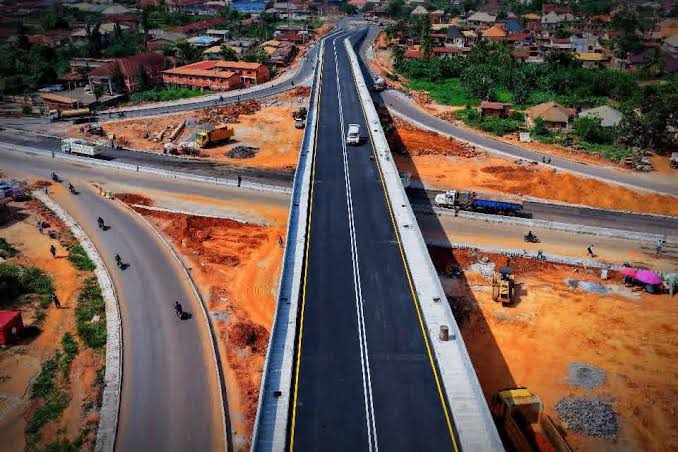
The issue of bridges and flyovers recently entered the national discourse following the defects observed on the Lameco Flyover in Osogbo, Osun State, constructed by the Ademola Adeleke administration.
With the Osun governorship election approaching, the opposition seized on the development, describing the project as a bogus and unnecessary white elephant that should never have been a priority.
The criticism generated widespread public attention, particularly on social media. The backlash eventually compelled Governor Adeleke to visit the site, where government officials attributed the damaged section to alleged sabotage.
It was against this backdrop that President Bola Tinubu cautioned state governments against embarking on what he described as “bogus projects,” including flyovers in locations where they may not be necessary.
It would therefore be inaccurate to suggest that the President was referring to the Oba-Adesida Flyover being constructed by the Governor Lucky Aiyedatiwa administration in Akure. At the time the President made that statement, the Lameco Flyover in Osogbo was the project dominating public debate.
Now, let us consider the justification for the two major flyover projects in Akure.
Between 2009 and the present, records from the Federal Road Safety Corps indicate that the Onyearugbulem/Shagari Village axis of the Akure expressway has witnessed at least nine fatal road accidents, in addition to numerous minor crashes.
One of the most devastating incidents occurred in 2022, when a trailer rammed into several vehicles and commercial motorcycles, claiming multiple lives.
That same night, Senator Yele Omogunwa Alasoadura visited the accident scene and pledged to work towards the construction of a flyover at the location, believing it to be the most effective long-term solution to the recurring tragedies. Former Governor Rotimi Akeredolu initiated the project, while Governor Lucky Aiyedatiwa eventually completed and commissioned it.
The traffic situation along the Cathedral–Oja-Oba corridor on Oba-Adesida Road also requires little explanation. For decades, successive administrations have struggled to address the persistent congestion and the frequent accidents involving pedestrians attempting to cross the busy highway.
As far back as 1991, the late Governor Bamidele Olumilua constructed the pedestrian bridge at Oja-Oba to improve safety and ease traffic flow. Subsequent governments introduced different traffic management measures, including barricading the road median. The Akeredolu administration later installed massive concrete barriers, which many residents nicknamed “Odi Jericho.”
Although the barriers helped improve traffic flow, they attracted widespread criticism from residents and traditional leaders.
Upon assuming office, Governor Aiyedatiwa responded to these concerns by removing the barriers. However, with their removal came the return of severe traffic congestion along the corridor.
Having explored several alternatives without achieving a lasting solution, the government has now opted for the construction of the Oba-Adesida Flyover. Beyond easing traffic congestion and improving pedestrian safety, the project is expected to enhance the aesthetic appeal of the state capital.
More importantly, the flyover represents a long-term investment in Akure’s future. With vehicle volume projected to increase significantly over the next five years, the infrastructure is designed not only to solve today’s challenges but also to accommodate the city’s anticipated growth.
