
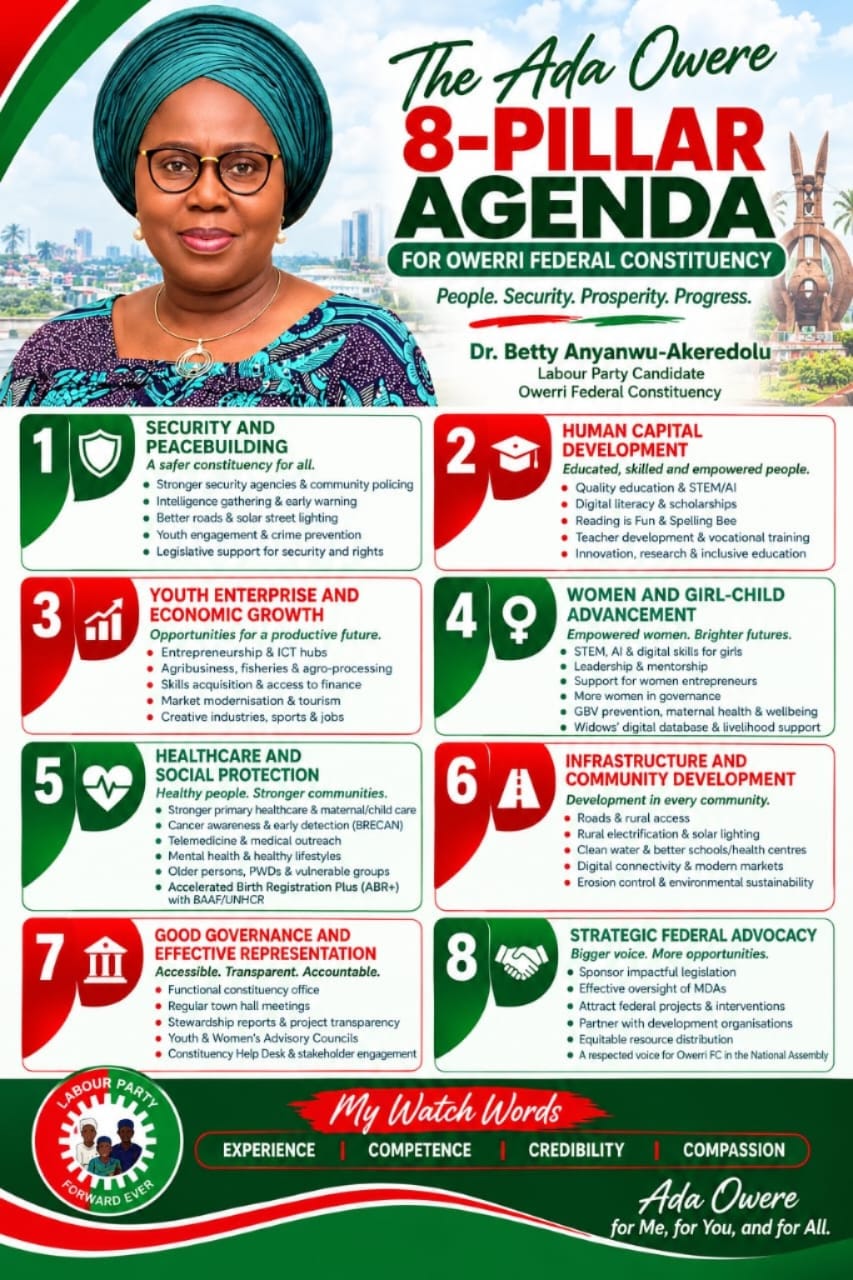
From security and education to healthcare, youth enterprise and infrastructure, the Labour Party candidate outlines a development blueprint anchored on opportunity, accountability and inclusive growth.
As political conversations gather momentum ahead of the 2027 general elections, Dr. Betty Anyanwu-Akeredolu, popularly known as Ada Owere, has outlined an eight-point development agenda aimed at addressing the socio-economic challenges confronting Owerri Federal Constituency in Imo State.
The Labour Party candidate for the House of Representatives seat, comprising Owerri Municipal, Owerri North and Owerri West, presents the agenda as a framework for a constituency where security, quality education, accessible healthcare, economic opportunities and accountable governance are treated as essential pillars of development.
Titled “Ada Owere Explains: The 8-Point Pillar Agenda,” the blueprint places people at the centre of public policy, with emphasis on improving living conditions, empowering women and young people, strengthening community infrastructure and ensuring that the constituency has a stronger voice in national decision-making.
At the heart of the agenda is the conviction that representation must go beyond political promises to purposeful advocacy, effective legislation, responsible oversight and sustained engagement with constituents.
Security and Peace Building: Restoring Confidence in Communities
The first pillar identifies security as a fundamental requirement for development, recognising the impact of kidnapping, armed robbery, banditry, terrorism and other violent crimes on livelihoods, investment and social stability.
According to Anyanwu-Akeredolu, the inability of citizens to travel safely, cultivate their farms, operate businesses or sleep peacefully in their homes represents a serious challenge that requires coordinated and sustained intervention.
She advocates a comprehensive approach that combines intelligence-led policing, modern technology, effective emergency response, community participation and preventive peace-building initiatives.
A central proposal is the establishment of state police as part of a broader reform of Nigeria’s security architecture. She argues that the country’s geographical diversity and varying local security challenges require policing arrangements that are responsive to community realities.
However, she stresses that state police must operate within constitutional safeguards, with professional standards, independent oversight and accountability mechanisms to prevent political abuse and protect citizens’ rights.
The agenda also proposes strengthening community vigilante groups through appropriate training, funding, equipment and supervision, while ensuring their collaboration with the Nigeria Police Force and other authorised security agencies.
For the candidate, community participation must be properly structured and supported rather than treated as a substitute for professional law enforcement.
She equally calls for stronger emergency reporting systems, coordinated rescue operations, support for victims of violent crime and security interventions targeting vulnerable farming communities, rural roads, markets and transport corridors.
Beyond enforcement, the agenda recognises the importance of addressing factors that can contribute to insecurity, including youth unemployment, social exclusion and unresolved communal disputes.
The underlying objective is to create safer communities where residents can pursue their livelihoods without persistent fear.
Human Capital Development: Investing in Education and Skills
Education and human capital development form another major component of the blueprint, reflecting the candidate’s position that access to quality education should not depend on a family’s financial circumstances.
She advocates free education from primary through secondary school, supported by improved classrooms, equipped laboratories, functional libraries, digital learning facilities and well-trained teachers.
The proposal also emphasises technical and vocational education, digital literacy and entrepreneurship as pathways for young people whose aspirations may extend beyond conventional academic qualifications.
For Anyanwu-Akeredolu, school enrolment alone is insufficient. Education must equip children with the knowledge, competence and practical skills needed to participate meaningfully in society and the economy.
The agenda cites international education-financing benchmarks, including UNESCO’s recommendations that countries allocate between 15 and 20 per cent of public expenditure, or four to six per cent of gross domestic product, to education.
It calls for more deliberate investment in schools, better support for teachers and greater accountability in the use of education funds.
The candidate maintains that improving educational outcomes requires a combination of adequate funding, sound policy, effective implementation and sustained public oversight.
Her vision is an Owerri where children from different social and economic backgrounds have a fair opportunity to learn, acquire skills and build productive futures.
Youth Enterprise and Economic Growth: Turning Potential into Prosperity
The third pillar focuses on youth enterprise and economic growth, with emphasis on moving beyond temporary empowerment initiatives towards sustainable opportunities for employment, entrepreneurship and innovation.
Anyanwu-Akeredolu argues that young people possess the creativity, energy and talent to contribute significantly to the economy but often lack access to practical training, affordable finance, mentorship and markets.
The agenda therefore proposes expanded vocational and technical training in information technology, digital services, fashion and garment production, electrical installation, renewable energy, construction, fabrication, food processing, aquaculture and other commercially viable fields.
It also seeks stronger support for small and medium-sized enterprises through entrepreneurship education, financial literacy, business-development services and access to appropriate government-backed funding programmes.
A major element of the proposal is the promotion of digital innovation and inclusive technology education.
The candidate points to her work through the BEMORE Empowered Girls Foundation, established in 2017, as part of her longstanding commitment to equipping girls with knowledge and practical skills in science, technology, engineering, mathematics and entrepreneurship.
The programme’s inclusion of girls with hearing impairments since 2022, according to the agenda, reflects the principle that disability should not prevent access to learning and economic opportunities.
She hopes to extend the culture of skills development and innovation across Owerri Federal Constituency, encouraging young people to develop viable ideas, establish businesses and participate in the digital economy.
The agenda also identifies agriculture, aquaculture, food processing, packaging, storage and distribution as areas capable of generating employment and expanding local economic activity.
With institutions such as the Federal University of Technology, Owerri, providing an important educational and research base, the candidate sees opportunities to strengthen connections between learning, innovation and enterprise.
She acknowledges, however, that a federal legislator cannot personally guarantee jobs, loans or grants. Rather, the proposed role is to promote supportive policies, facilitate access to existing programmes, exercise legislative oversight and advocate for fair opportunities for qualified constituents.
Women and Girl-Child Advancement: Making Inclusion a Development Priority
The fourth pillar places women’s advancement at the centre of the constituency’s development prospects.
It argues that women are not merely recipients of social interventions but important contributors to household welfare, entrepreneurship, agriculture, professional services and community development.
The agenda proposes improved access to education for girls, economic support for women-owned businesses, digital and vocational training, better healthcare and stronger protection against violence, abuse and discrimination.
It also advocates greater participation by women in leadership and decision-making, maintaining that the constituency cannot fully utilise its human resources if women are excluded from positions where policies and priorities are determined.
For market women, artisans, farmers and small-business owners, the proposed interventions include improved financial inclusion, business-development support and access to wider markets.
The candidate also highlights the need to expand opportunities for girls in science, technology, engineering and mathematics, drawing on her experience with BEMORE.
Her position is that girls should be prepared not only to participate in the modern economy but also to become innovators, professionals and future leaders.
The pillar further emphasises the importance of maternal health, reproductive healthcare and protection from gender-based violence.
Through legislative advocacy, constituency engagement and partnerships with relevant institutions, she says she will pursue measures intended to expand opportunities for women and girls across Owerri Municipal, Owerri North and Owerri West.
Healthcare and Social Protection: Putting People First
Healthcare and social protection constitute the fifth pillar, built around the argument that development loses much of its value when people cannot obtain medical attention because of financial or geographical barriers.
The agenda proposes stronger primary healthcare services, better-equipped health centres, adequate supplies of essential medicines, qualified health workers and improved access to medical facilities.
Maternal and child health receive particular attention, with emphasis on antenatal care, safe delivery, immunisation and proper nutrition.
The candidate also calls for greater attention to cancer awareness, screening and early diagnosis, including breast, cervical and prostate cancer.
Her longstanding involvement in breast cancer advocacy through BRECAN informs this aspect of the agenda, which seeks greater government support for accessible screening services and timely medical intervention.
The proposal also recognises the circumstances of older persons, persons with disabilities, vulnerable households and families experiencing economic hardship.
For these groups, social protection is presented as an essential means of preserving dignity, improving well-being and reducing the risk that illness or financial distress will push families further into poverty.
As a prospective federal lawmaker, Anyanwu-Akeredolu says she will advocate for increased healthcare investment, scrutinise public health expenditure and work with relevant agencies, healthcare providers and community organisations to advance practical solutions.
The objective is a healthcare system in which preventive services are accessible, primary healthcare facilities are functional and vulnerable citizens are not left without support.
Infrastructure and Community Development: Bringing Development Closer to the People
The sixth pillar broadens the development conversation to include roads, healthcare facilities, schools, markets, water, sanitation, lighting and other essential community infrastructure.
The agenda argues that infrastructure should be assessed not merely by the number of projects completed but by how effectively those projects improve people’s daily lives.
Improved roads, for instance, are presented as important for commerce, access to schools and healthcare, and emergency response. While poor roads do not cause kidnapping, difficult access routes can make it harder for security personnel and emergency services to reach vulnerable communities promptly.
The candidate therefore proposes advocating for improved roads and access routes connecting communities and supporting economic activity.
She also emphasises the need for functional primary healthcare centres, with essential medicines, clean water, reliable electricity, basic diagnostic capacity and effective referral systems.
For schools, she argues that infrastructure must be matched by qualified teachers, learning materials, water and sanitation facilities to ensure that children receive meaningful education.
A particularly notable proposal concerns the modernisation of markets, which the agenda describes as essential workplaces for women and other small-scale traders who contribute substantially to the local economy.
The candidate has identified three markets for proposed improvements: Orie Obibi Market in Owerri North, Nkwo-Ukwu Market in Ihiagwa, Owerri West, and Relief Market in Owerri Municipal.
The proposed improvements include better drainage, waste management, clean water, public toilets, lighting, access roads, loading areas and improved security.
These interventions, she argues, would help create healthier trading environments, improve public sanitation and support the livelihoods of traders and their families.
She says she will pursue the proposals through engagement with relevant authorities and development partners, while advocating transparent and accountable implementation.
The broader commitment is to promote infrastructure that responds to community needs and distributes development opportunities more equitably across the constituency.
Good Governance and Effective Representation: Accountability as a Public Duty
The seventh pillar focuses on governance, transparency, accessibility and accountability.
It presents representation as a public responsibility that requires listening to constituents, communicating regularly, monitoring public projects and ensuring that government decisions reflect the interests of the people.
The agenda identifies five guiding principles: accessibility, transparency, accountability, people-centred representation, and effective oversight focused on results.
Anyanwu-Akeredolu proposes open channels through which constituents can raise concerns, offer suggestions and obtain updates on issues affecting their communities.
She also pledges to advocate for clear information about public projects, including their funding, implementation progress and intended benefits.
The approach is intended to give residents a stronger role in public decision-making, particularly groups whose concerns may receive insufficient attention, including women, young people, traders, farmers and persons with disabilities.
The candidate recognises that a federal lawmaker does not control every government project or agency. Nevertheless, she argues that the office carries a responsibility to ask questions, scrutinise public expenditure, pursue explanations for delays and communicate progress to constituents.
Through legislation, motions, petitions, committee work and oversight, she says she will seek practical solutions while remaining answerable to the people she hopes to represent.
The emphasis is on a system of representation in which public trust is earned through openness, responsible conduct and demonstrable effort rather than political rhetoric.
Strategic Federal Advocacy: Giving Owerri a Stronger Voice
The eighth pillar centres on strategic federal advocacy, outlining how the candidate intends to use the legislative responsibilities of the House of Representatives to advance the interests of Owerri Federal Constituency.
The agenda identifies lawmaking, budget consideration, legislative oversight, constituency advocacy and engagement with federal ministries, departments and agencies as key instruments for pursuing development priorities.
It proposes supporting or sponsoring legislation that expands opportunities, strengthens public services and promotes inclusive development.
On budgetary matters, the candidate says she will advocate for appropriate funding for projects and programmes relevant to the constituency, while acknowledging that budget decisions are collective legislative processes.
She also proposes using committee work and other lawful oversight mechanisms to monitor the implementation of approved federal projects, question delays and scrutinise the use of public resources.
Other priorities include advocating for federal interventions in infrastructure, education, healthcare, skills development, entrepreneurship, women’s economic advancement and community development.
The agenda further promises regular communication with constituents on issues raised, responses received, progress made and obstacles encountered.
Anyanwu-Akeredolu acknowledges that a member of the House of Representatives cannot unilaterally determine all budget allocations, compel every project or directly manage federal agencies.
Her stated objective is instead to use the legislative powers available to her, build constructive partnerships and persistently pursue the constituency’s interests in national policy discussions.
A Unified Vision for Owerri
Taken together, the eight pillars present a development framework that connects security with economic activity, education with employability, women’s empowerment with household welfare, healthcare with social protection, and infrastructure with inclusive growth.
The agenda also places accountability at the centre of implementation, recognising that policies and proposals must be supported by effective oversight, responsible spending and measurable outcomes.
For Owerri Municipal, Owerri North and Owerri West, the vision is a constituency where residents can live in safer communities, children can access quality education, young people can develop marketable skills, women can expand their businesses, families can obtain healthcare and communities can benefit from improved public infrastructure.
The candidate’s approach also acknowledges the limits of legislative office, distinguishing between what a federal representative can directly undertake and what must be pursued through advocacy, partnerships, legislation and oversight.
That distinction is important to assessing the agenda: its impact would ultimately depend on the availability of funding, cooperation among the different levels of government, the quality of implementation and the ability to translate proposals into measurable improvements in people’s lives.
As the 2027 elections approach, Anyanwu-Akeredolu is presenting the eight-point agenda as her proposed basis for representation, with the promise of placing people, opportunity and accountability at the heart of her legislative priorities.
For her, the central message is that development should be felt in the everyday experiences of ordinary citizens—in safer homes and roads, better schools and healthcare facilities, thriving businesses, empowered women, productive young people and public institutions that remain answerable to the people.
Her campaign slogan captures that aspiration: “Ada Owere — For Me, For You, and For All.”
