
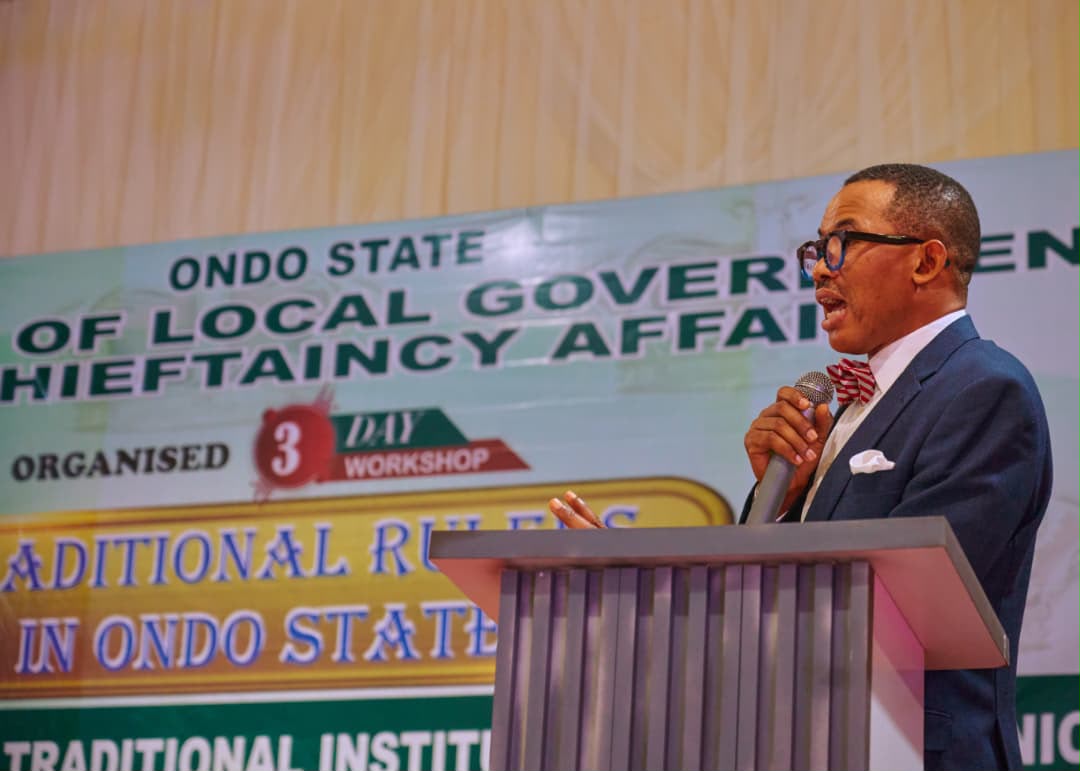
The Ondo State Attorney-General and Commissioner for Justice, Dr. Olukayode Ajulo, SAN, OON, has urged traditional rulers across the state to exercise their authority within the provisions of the Constitution and other relevant laws.
Ajulo said the strength of the traditional institution was not only in the crown but also in the trust and confidence reposed in it by the people.
The Attorney-General spoke on Tuesday at the International Culture and Event Centre, The Dome, Akure, during a three-day workshop organised for traditional rulers by the Ondo State Ministry of Local Government and Chieftaincy Affairs.
The workshop, with the theme, “Repositioning the Traditional Institution for Harmonious Communal Relationship, Security, Cultural Preservation and Sustainable Development,” focused on strengthening the role of traditional institutions in governance, peace-building, security, cultural preservation and community development.
Ajulo, who spoke on the legal and constitutional limitations of traditional authority, said traditional rulers operate within a constitutional democracy and must understand the distinction between customary authority and powers vested by law in the courts, police and other statutory institutions.
He noted that the Constitution did not establish the office of an Oba as a fourth arm of government, but recognised the role traditional institutions could play in local governance and community development.
According to him, traditional rulers should see themselves as custodians of history and culture, symbols of communal identity, peace-builders, mediators and community mobilisers rather than alternative courts or government institutions.
The Attorney-General warned traditional rulers against turning their palaces into detention centres or criminal courts, stressing that allegations of criminal conduct must be handled by legally authorised law-enforcement agencies.
“An Oba should not order the indefinite detention of a person because that person is accused of stealing, insulting the palace, owing money, violating a community rule or participating in a dispute,” he said.
Ajulo urged traditional rulers to identify criminal conduct, preserve peace, provide relevant information and cooperate with security agencies instead of investigating, detaining or punishing suspects themselves.
He also emphasised the importance of fair hearing in traditional administration, saying traditional rulers would not lose their dignity by listening to all sides in a dispute.
He encouraged traditional institutions to embrace mediation and customary arbitration where appropriate, but cautioned that such processes must be voluntary and clearly distinguished from judicial adjudication.
On land disputes, Ajulo cautioned traditional rulers against resorting to self-help, particularly in cases involving alleged land grabbing, intimidation, forceful entry and illegal occupation.
He advised palaces to preserve peace and refer such matters to the appropriate statutory authorities, including the Anti-Land Grabbing Task Force where applicable.
The Attorney-General further highlighted the role of traditional rulers appointed as Justices of the Peace, saying such appointments did not confer unlimited judicial powers on them.
He said the Oba-JP should instead serve as a peace-builder, mediator, community justice link, early-warning actor and facilitator of lawful dispute resolution.
Ajulo also urged traditional rulers to strengthen their contribution to the state’s security architecture by providing credible community intelligence to government and security agencies.
He observed that traditional rulers often receive information about impending communal violence, land disputes, kidnapping threats, cult activities, illegal mining, farmer-herder tensions and criminal networks before such information gets to government agencies.
He, however, cautioned them against transforming their institutions into alternative security agencies.
The Attorney-General urged traditional rulers to maintain functional relationships with the state government, the Nigeria Police Force, Department of State Services, Amotekun Corps, Nigeria Security and Civil Defence Corps, local government authorities and other lawful security structures.
He advocated continuous legal education for traditional rulers through periodic workshops on constitutional law, chieftaincy law, customary arbitration, land law, anti-land-grabbing legislation, human rights, criminal justice, mediation and peace-building.
Ajulo also proposed the establishment of palace mediation desks, land-dispute referral protocols, security early-warning networks, access to competent legal advisers, proper documentation of palace proceedings, youth engagement and stronger mechanisms for resolving disputes between neighbouring kingdoms.
On cultural preservation, he urged traditional institutions to protect indigenous languages, oral history, royal genealogies, traditional festivals, music, historical sites, indigenous arts and crafts, as well as traditional knowledge.
He said traditional rulers could also contribute to sustainable development by attracting responsible investment, resolving community disputes, protecting legitimate investors, discouraging illegal land practices, promoting agriculture, protecting forests and natural resources, supporting education and skills development, and encouraging youth entrepreneurship.
Ajulo stressed that investors needed certainty, communities wanted fairness and government desired development, adding that traditional institutions could help bring the three interests together.
He said repositioning the traditional institution should not be seen as an attempt to diminish the authority of the palace but as a way of ensuring that its moral and cultural authority was exercised effectively within the constitutional order.
“Traditional rulers must understand when to intervene and when to refer, when to mediate and when to step aside, and when a matter is customary and when it has become criminal,” the Attorney-General said.
