
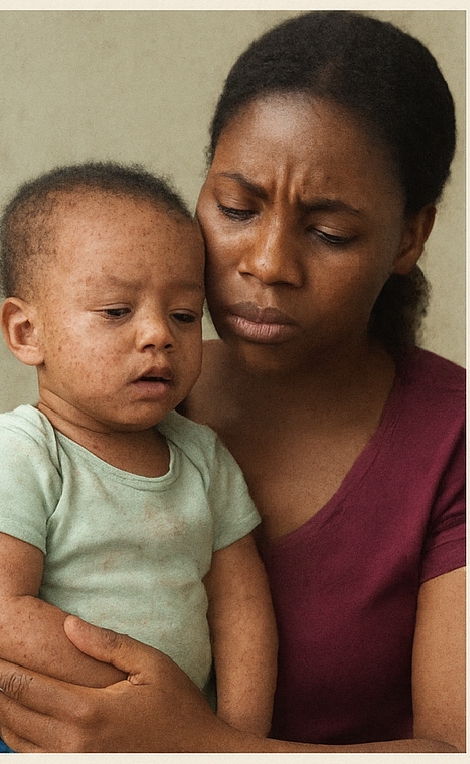
At a small primary healthcare centre in Isinkan, Akure South Local Government, a young mother sits anxiously with her two children.
She is waiting for their measles-rubella vaccination, an appointment she missed two years ago when the pandemic disrupted movement, schooling, and access to health services.
She is not alone. Across Nigeria today, thousands of parents are making similarly overdue trips, driven by fear, reminders from health workers, or recent reports of outbreaks sweeping through communities.
Nigeria is facing a fresh surge of measles and rubella infections, a worrying trend that experts say reflects a widening crack in the nation’s childhood immunisation shield.
Surveillance reports from national health authorities show that more than 9,000 measles cases were confirmed in 2024, with several deaths recorded, particularly among unvaccinated children.
Rubella, often overshadowed by the more dramatic symptoms of measles, also resurfaced in several underserved communities.
These numbers mirror a global pattern. The World Health Organisation estimates that over 10 million measles infections occurred worldwide in 2023, resulting in more than 95,000 deaths, mostly involving unvaccinated children under five.
Health workers say the resurgence is not surprising. During the COVID-19 years, many children missed routine immunisation. Insecurity displaced families from stable healthcare services. Myths and misinformation created fresh resistance to vaccines.
“We are dealing with the aftershocks,” a public health official said. “The immunity gap is real, and unless we close it, outbreaks will continue.”
Though often paired in public discussions, measles and rubella are distinct diseases.
Measles is extremely contagious—one sick child can infect nearly everyone around who is unvaccinated. It begins with high fever, cough, runny nose, and red eyes before progressing to a full-body rash. Complications such as pneumonia and brain inflammation can make measles life-threatening.
Rubella, or German measles, is milder. Some children show no symptoms beyond a mild rash or low fever. However, it is highly dangerous for pregnant women, as infection can cause miscarriage or severe birth defects known as congenital rubella syndrome (CRS).
Both illnesses are preventable with the measles-rubella (MR) vaccine, described by experts as one of the most cost-effective and reliable tools for saving young lives.
In underserved areas – from parts of Zamfara to communities in Ondo State – health workers encounter children who have never received a single vaccine dose.
Some families live far from accessible health centres; others battle insecurity or entrenched mistrust of medical interventions.
“We saw clusters of cases in places that had been quiet for years. Once one child gets sick, the spread can be explosive.” a surveillance officer said
To prevent further spread, the government and development partners are rolling out targeted immunisation campaigns in high-risk communities. Mobile vaccination teams are moving from house to house, while radio jingles and town criers encourage parents to bring their children forward.
“Every child missed is a child at risk. We must reach them all.” Immunisation coordinator said.
Public health experts stress that the media remains one of the strongest forces in combating vaccine misinformation. By promoting verified health information and amplifying updates on immunisation campaigns, journalists can help communities make informed decisions.
“The media shapes behaviour, responsible reporting saves lives.” Communication Expert noted
As Nigeria confronts rising outbreaks, health officials remain firm: vaccination works, and it remains the country’s strongest defence.
The MR vaccine is free, safe, and available at government-approved health facilities nationwide, including centres in Akure South and other local government areas.
For the young mother in Isinkan, the decision is simple.
“I just want my children safe,” she says quietly as a nurse calls their names.
In the ongoing fight against measles and rubella, that simple desire – shared by millions of parents – may be Nigeria’s most powerful weapon.
